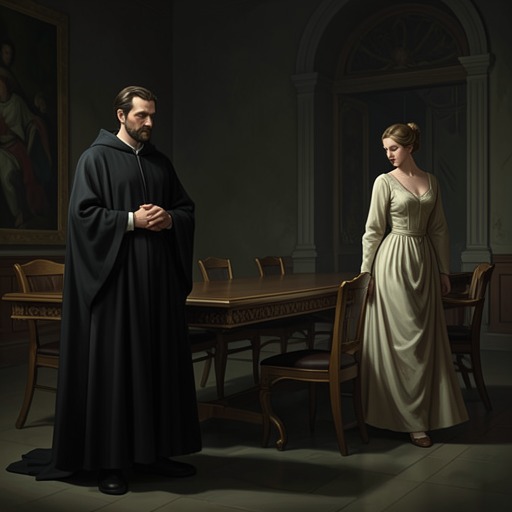
Septon Alfyn
Fire & BloodSepton Alfyn rose from an itinerant preacher carried in a litter to High Septon, becoming one of the most forceful public advocates of the Doctrine of Exceptionalism. His journey through the Reach gave the king’s religious argument a recognizable voice, and his election placed that argument at the head of the Faith of the Seven. His advancement joined personal reputation, royal policy, and the politics of choosing the Faith’s leader.
Identity and Mission
Alfyn was the oldest of the Seven Speakers sent out by King Jaehaerys to speak in favor of the king and Queen Alysanne. He had lost the use of his legs years earlier and traveled in a litter. The account presents this as a practical circumstance of his work: he crossed the Reach repeatedly on the queen’s behalf, making the journey a dozen times. His age and mobility did not keep him from an itinerant role that required sustained travel and public argument.
Alfyn was one of three septons among the Seven Speakers, alongside the cunning Septon Baldrick and the learned Septon Rollo. The group’s task was to defend the royal marriage and the queen’s standing through persuasion rather than force. They praised Alysanne’s piety, generosity, and love for the people of the kingdom, while also answering religious objections to the Targaryen custom of sibling marriage. Alfyn’s fierce advocacy made him, in the account’s assessment, the strongest champion of Exceptionalism in the Seven Kingdoms.
The Doctrine of Exceptionalism
The central argument Alfyn carried was devised in King’s Landing by Jaehaerys, with Septon Oswyck and especially Septon Barth assisting. The Seven Speakers used it to answer challenges based on the Seven-Pointed Star and sermons by earlier High Septons. Its reasoning did not deny the Faith’s general prohibitions on incestuous unions. Instead, it argued that the Targaryens were an exception: their ancestry and traditions came from Valyria rather than Andalos, and their command of dragons marked them as different from other peoples.
Alfyn gave this case a memorable public form. Speaking from his litter, he compared the differences between peoples to those between a lion and an aurochs: both could be noble, yet neither was made to live as the other. The comparison supported the Exceptionalists’ claim that the rules applying to ordinary people did not necessarily govern the Targaryens. In this way, the doctrine joined an appeal to religious authority with an argument from visible difference and the extraordinary power of dragons. Alfyn was not identified as the doctrine’s author; his importance lay in making the king’s carefully prepared case persuasive in public.
Election as High Septon
Alfyn’s preaching career became the basis of an unexpected elevation. During the royal progress, Jaehaerys made clear that he wanted a new High Septon who accepted Exceptionalism and would prevent the Starry Sept from challenging the Targaryen marriage tradition. In Oldtown, the Most Devout required four ballots to choose their new leader. Septon Mattheus led the first ballot but did not win the votes needed for the crystal crown; his support then declined as other candidates gained ground.
On the fourth ballot, the Most Devout broke tradition by choosing a man who was not one of their own number. They selected Alfyn, whose repeated journeys through the Reach had made him an established royal advocate. The choice was striking not only because he stood outside the electing body, but because he was old and dependent on a litter for travel. The narrative describes him as astonished when news reached him at Ashford. His journey to Oldtown took more than a fortnight, a delay that also gave Jaehaerys time to visit several other seats in the Reach.
Royal Bargain and Consecration
Septon Barth’s account connects Alfyn’s election to a political understanding with Lord Donnel. Jaehaerys promised that a Hightower would succeed Alfyn, provided Lord Donnel’s kin firmly supported the Exceptionalists during Alfyn’s tenure. The account presents the arrangement as a bargain, not simply a spontaneous religious choice. Barth lamented that the Most Devout could be manipulated, while judging both Alfyn and Lord Donnel’s brother, who did later succeed Alfyn, more worthy of the crystal crown than Septon Mattheus. His record therefore preserves both the policy’s achievement and the unease surrounding the means used to secure it.
After reaching Oldtown, Alfyn stood vigil in the Starry Sept and was anointed and consecrated to the Seven. In assuming the office, he forsook his earthly name and ties. He then blessed Jaehaerys and Alysanne in a solemn public ceremony. This blessing gave the royal couple a visible religious endorsement from the new head of the Faith, following a campaign that had sought acceptance through argument rather than armed enforcement.
Significance
Alfyn’s career links the Seven Speakers’ travels to the institutional consequences of their mission. The account says the realm did not rise against Jaehaerys and Alysanne in 51 AC as it had against Aegon and Rhaena ten years earlier, but it cautions that the reasons are uncertain. The High Septon’s silence, the realm’s weariness of war, and the speakers’ efforts may all have contributed. Alfyn’s later election gives particular weight to that last possibility: the preacher who had carried the Exceptionalist case across the Reach became the Faith’s leader.
His role also shows the difference between public persuasion and the political machinery behind it. On the road, Alfyn argued that Targaryen difference justified an exception; in Oldtown, the king’s priorities and a promised Hightower succession helped determine who would hold the crystal crown. The account does not reduce his work to that bargain, since he had already traveled widely and become a noted advocate. But his rise shows how that advocacy could serve both as religious argument and as the foundation for a negotiated settlement between the crown and powerful members of the Faith.